
Lighting for Virtual Production
Antilatency presents a new lighting solution tailored specifically for Virtual Production environments. This fixture has been engineered with a focus on essential features, removing unnecessary elements to deliver maximum performance where it truly matters.
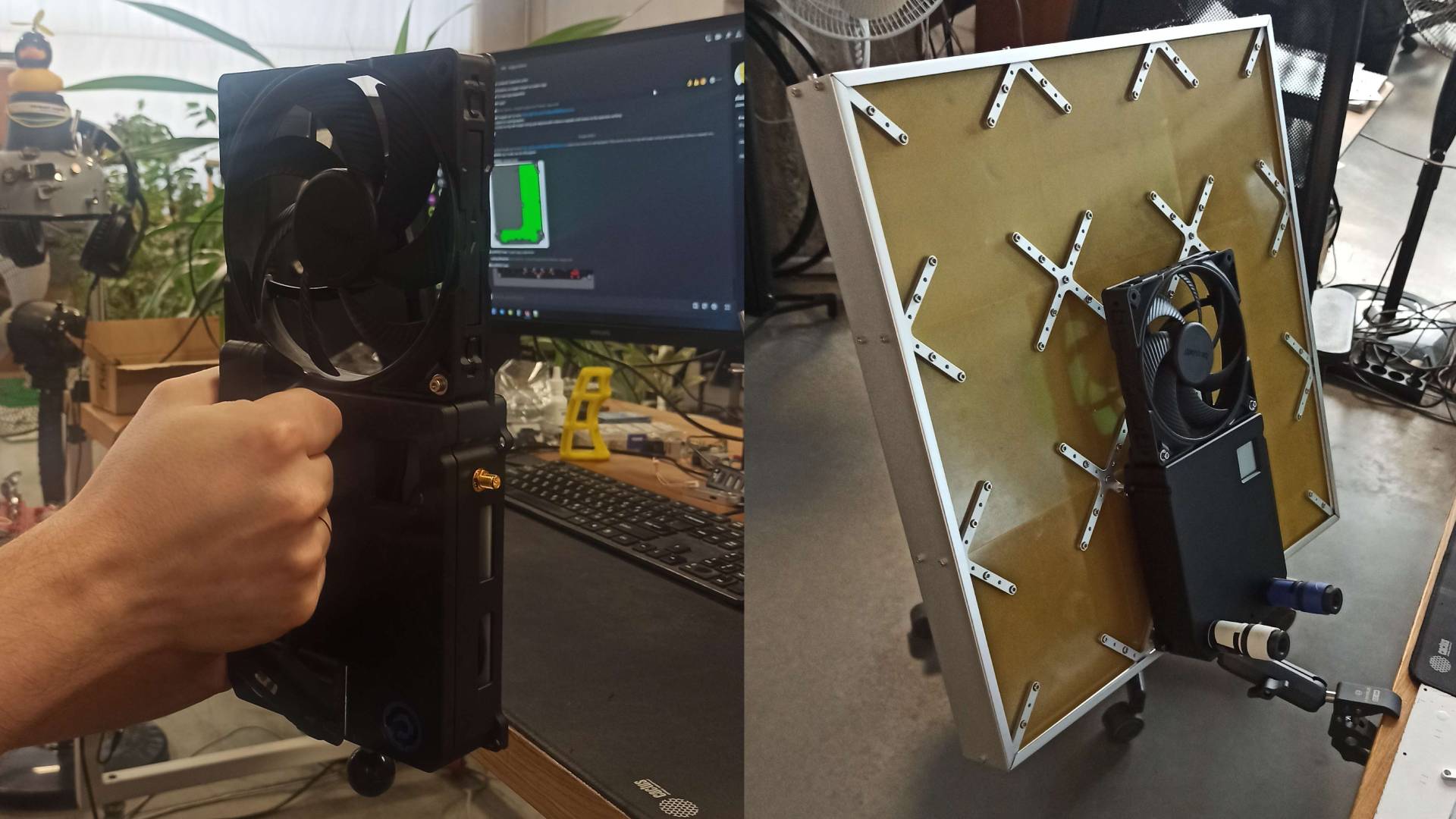 The lighting fixture is currently in the development stage.
Designed for Studio Use
This fixture is intended exclusively for indoor studio use, so it does not include weatherproofing. In return, the design achieves an exceptionally low weight of 3.2 kg (243 W model), including the power and control module.

This light weight reduces the structural demands on mounting systems like trusses and pantographs—lowering their cost, simplifying installation, and increasing overall efficiency. The minimal weight is achieved in part because all structural elements are load-bearing, including the diffuser.
Surface-Area-to-Power ratio
This lighting fixture is intentionally designed with a high surface-area-to-power ratio, meaning its power is distributed across a larger surface. This not only eliminates the need for additional diffusers, but also significantly improves heat dissipation, removing the need for bulky heatsinks.
Control Interface
Since direct physical access to the fixture is usually limited or inconvenient in studio environments, manual controls are not considered essential. The device does not include any physical controls such as knobs or buttons. The fixture is designed for computer-only control, and an E-Ink display provides real-time status and information about the current command source.
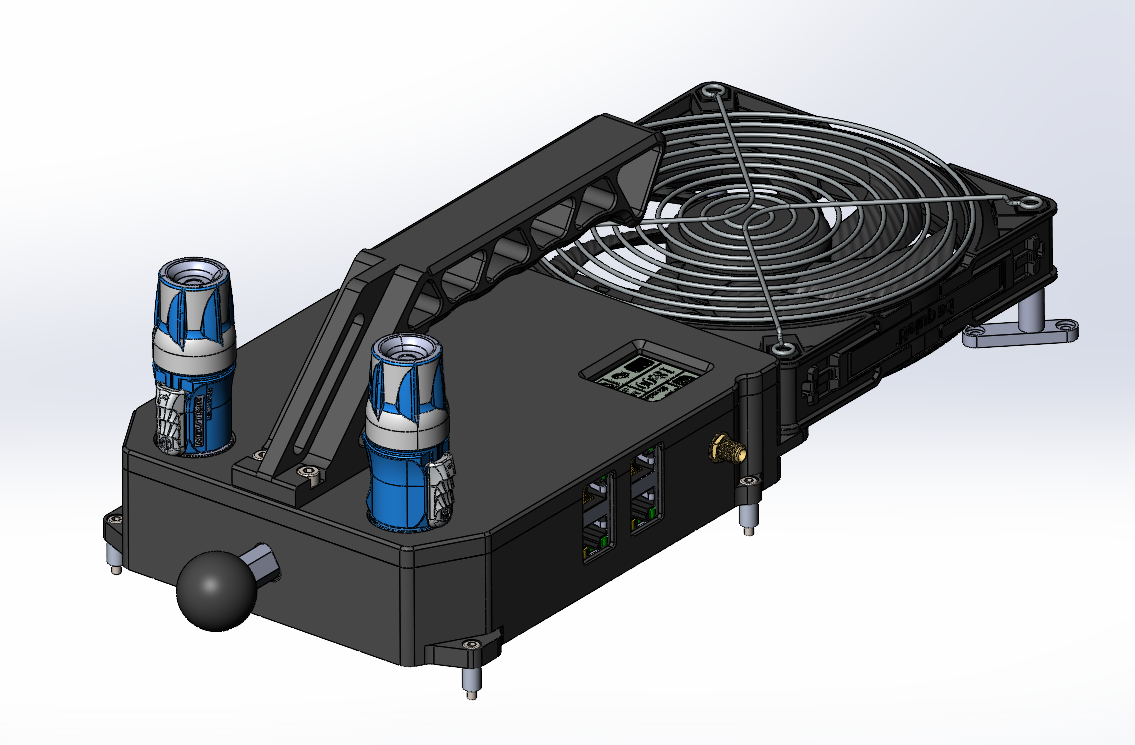
The fixture supports Ethernet/WiFi -> UDP -> Art-Net for control. Unlike DMX, Art-Net is a bidirectional protocol that continuously monitors fixture availability—ensuring that any power or signal loss is immediately detectable during production.
Additionally, manual control is available via a web browser interface, allowing convenient access to all connected fixtures—or selected groups of fixtures—from a single page. This provides a simple and centralized way to manage lighting across the entire network without needing physical access.
The device provides four equivalent Ethernet ports, all part of an internal Ethernet switch, which is also internally connected to the control board. This allows fixtures to be connected directly to each other—not just to a router—greatly simplifying system wiring.
For power, the device uses a standard 120/220V PowerCON input, along with a PowerCON output, allowing multiple fixtures to be daisy-chained together.
Energy Efficiency
Compared to most LED panels on the market, this fixture delivers 35% more luminous output per watt (based on test results). This is made possible by the use of dielectric mirrors as internal reflectors beneath the diffuser, covering all inner surfaces of the light chamber.
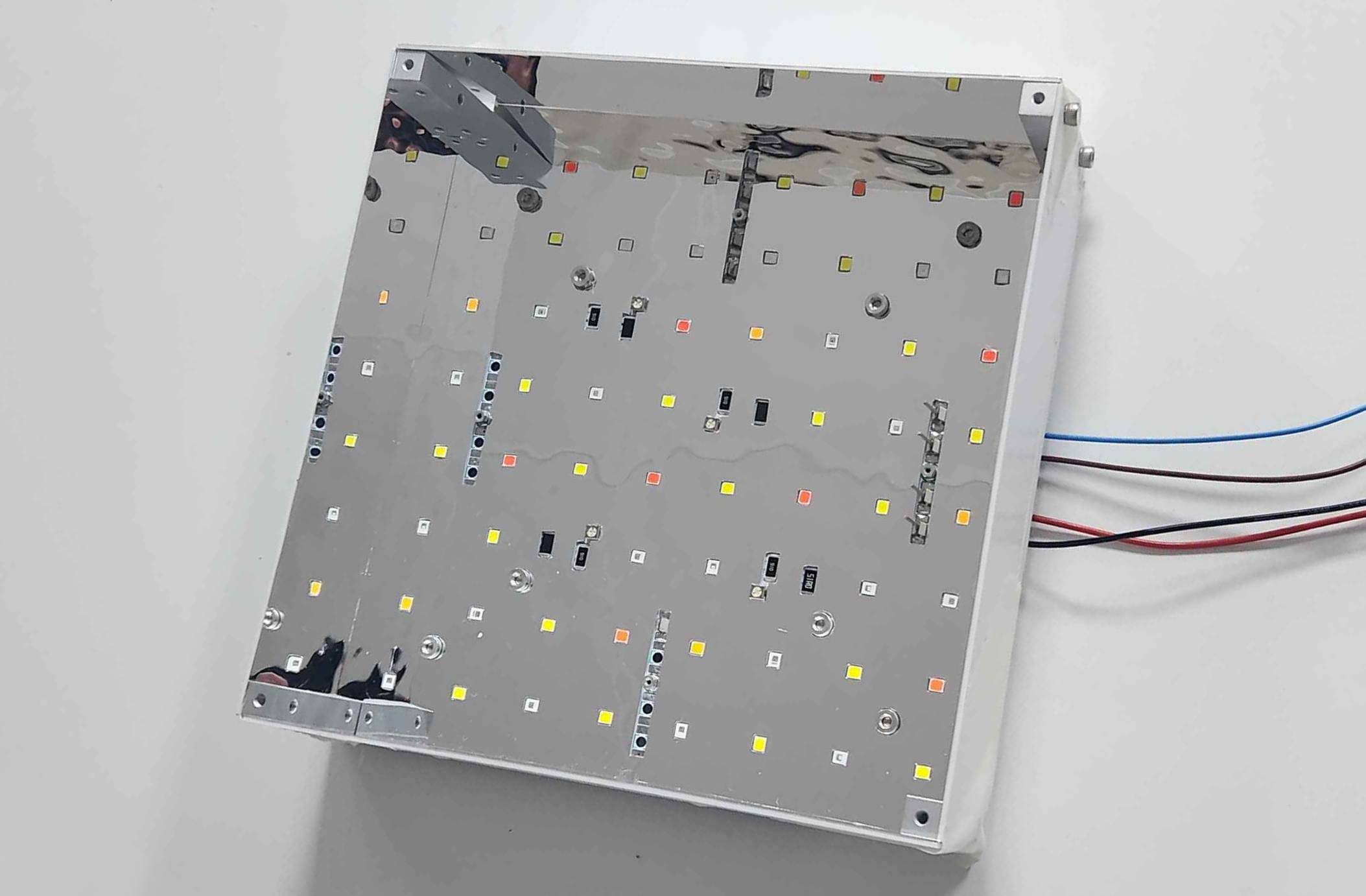
Dielectric mirrors offer 98% reflectivity, unlike traditional PCB surfaces which reflect less than 80%.
The operating principle of all diffuser-based panels is the same. Light attempts to exit the internal chamber through the diffuser. As it passes through, it splits into two nearly equal parts: one leaves the fixture, while the other is reflected back into the chamber. This reflected light then bounces off the internal surfaces and tries again to escape through the diffuser. As a result, the reflectivity of the internal surfaces is a key factor in achieving high efficiency.
Spectral Quality
The primary goal is to replicate natural light as closely as possible. To achieve this, the fixture uses seven types of LEDs, including three phosphor-based types. These are chosen to produce a smooth, continuous spectrum with no sharp gaps or peaks.
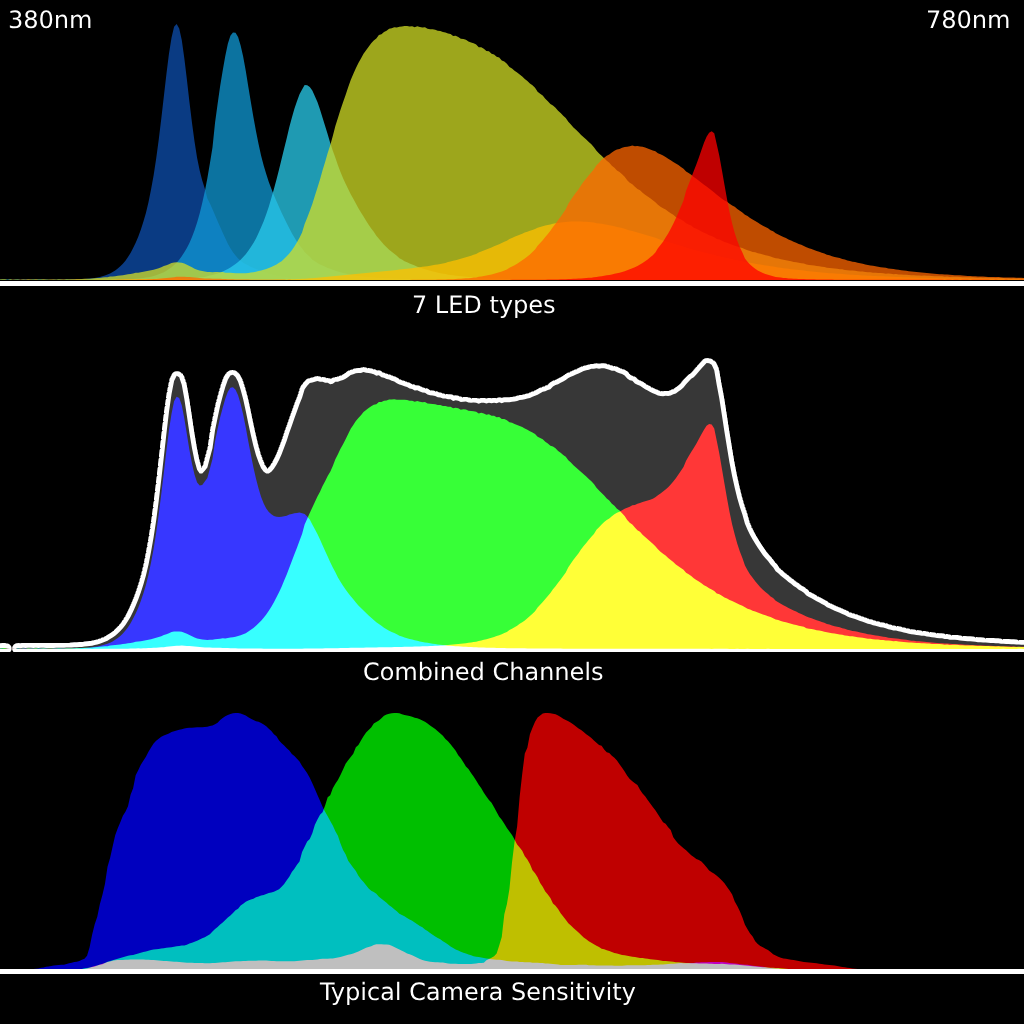
The LEDs are divided into three control groups, allowing flexible spectral shaping while maintaining spectral smoothness. White light is generated using all LEDs simultaneously, ensuring that in most neutral lighting setups, the fixture operates close to 100% of its total output capacity. There are no artificial power limits—all LEDs can be driven at full strength.
Thanks to the use of deep red (660nm) and deep blue (450nm) emitters, the fixture provides broad spectral coverage that matches the full sensitivity range of professional digital cinema cameras.
It’s also worth noting that this fixture is capable of producing exceptionally high-quality white light compared to standard white LEDs, which typically exhibit a spectral dip around 480 nm.
Settings and Modes
There are no adjustable settings and only one operating mode.
Settings on traditional lighting fixtures often create a problem: when beginning work, there’s no guarantee the fixture is still configured correctly after the previous operator. This can lead to unpredictable results or wasted time checking and resetting parameters. By eliminating all user-adjustable options, this fixture ensures consistent, reliable behavior every time it’s powered on.
Materials
The fixture is constructed from aluminum and fiberglass, offering strength, durability, and minimal weight.
Modular Configurations
The fixture is modular and available in the following configurations:
| Configuration | Total Size (mm) | Power Consumption |
|---|---|---|
| 3×3 modules | 500 × 500 | 243 W |
| 4×4 modules | 680 × 680 | 432 W |
| 5×3 modules | 820 × 500 | 405 W |
Accessories
- Mounting frame for assembling panel clusters
- Reflective side panels for light distribution control
- Positioning handle for fixture positioning (included but detachable to reduce weight)